
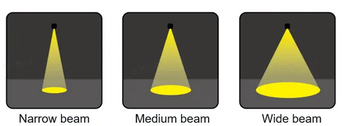
Beam angle describes the spread of a light beam under a stated measurement convention. A narrower beam concentrates light into a smaller area, while a broader beam spreads it more widely. The angle alone does not determine room coverage or visual comfort.
Distance changes the footprint
The same beam spreads across a larger area as the distance to the surface increases. Mounting height, aiming and the shape of the actual distribution all affect the result. A beam edge is not necessarily a sharp border, so use the photometric information where available rather than imagining an evenly lit cone with an abrupt end.
Match the spread to the purpose
A focused beam can draw attention to a small object or area, while a broader distribution can help with general coverage. Several overlapping beams can create a different effect from a single brighter source. Check for shadows, bright spots and gaps on the real wall or worktop; do not choose spacing solely from the bulb’s wattage.
Check the product rather than the family name
Two GU10 bulbs or ceiling fittings can have different optics despite similar housings. Compare the exact variant and its intended mounting. For desk work, also consider the direction of the source relative to the screen and your eyes. A wide angle is not automatically glare-free, and a narrow angle is not automatically more efficient.
Related choices and guides
Frequently asked questions
Does beam angle tell me lumens?
No. Beam distribution and total light output are different properties.
Can one spacing rule fit every ceiling?
No. Mounting height, geometry, output and the desired lighting effect all matter.







