
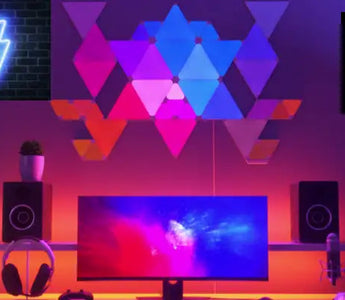
Choose a lighting shape by the composition you want to see from your chair. Lines can outline a surface, tabletop blocks can form a compact feature, and wall modules can create a larger pattern. Those visual roles do not make their kits interchangeable.
Sketch the negative space too
Draw the screen and furniture before the light pattern. Leave a clear border around the display and space between elements so the design remains readable. Check the outline from the usual seated position: a pattern that looks balanced straight-on may look crowded from the side. Start with fewer elements rather than assuming that more modules improve the result.
Match geometry to the physical format
- A strip follows a supported route; bends, joints and cutting must follow the actual instructions rather than the drawing alone.
- Cube modules make a tabletop assembly with the correct base. Their magnetic joining system is not permission to wall-mount a stack.
- Decorative wall panels need their compatible standard equipment and an approved mounting surface; an expansion alone is not a starter system.
Check the pattern with the effect stopped
Review a steady scene as well as any supported movement. Make sure the chosen shape does not put bright emitters or reflections directly in view. Choose reactive functions separately: the outline or number of sides does not tell you whether a product supports music, software games or direct screen matching.







