
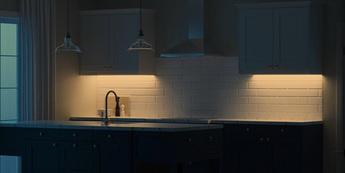
Lighting beneath a cabinet should illuminate the surface you actually use without exposing a bright source in your normal view. A kitchen worktop and the inside of a wardrobe are different environments; do not choose one product for both based on shape alone.
Decide what needs illumination
For a worktop, check where preparation takes place and whether the cabinet edge will cast a shadow. For a wardrobe, the need may be local light only when reaching inside. A motion sensor can be useful for an access task, but automatic shutoff may be unsuitable for a long stationary task unless the model offers an appropriate supported mode.
Respect the environment and power route
Water, steam, grease and heat can make a kitchen location unsuitable for a product intended for a dry cupboard. The closet-light manual specifies indoor use and warns against water exposure. Do not infer splash protection from a magnetic mount. Keep cables and power equipment clear of hot surfaces and follow the product’s stated installation conditions.
Test before fixing a continuous run
For a strip, check the standard kit, permitted length and any approved connectors before fitting it beneath cabinetry. Decorative colour features are not proof of appropriate worktop illumination. Test shadows, hotspots and reflections on the actual surface. Leave charging ports, controllers and service connections accessible rather than sealing them behind panels.
Related choices and guides
Frequently asked questions
Is a closet sensor light automatically suitable above a sink?
No. Sensor operation and moisture suitability are different requirements.
Does a strip extension work on its own?
Do not assume it does. Extensions must be matched to the complete system specified by the manufacturer.







