
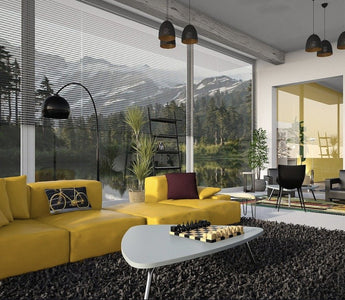
Plan the living room around how people use its seats, not around a single bright ceiling point. A useful arrangement lets conversation, reading and television coexist without forcing every light to the same level.
Draw the seating and sightlines first
Mark the sofa, chairs, television and routes through the room. From each seat, look for exposed sources and screen reflections. A light that looks hidden while standing may be directly visible when you lean back. Try positions before committing to fixed installation.
Give reading its own useful light
Check the page or activity surface from the seat actually used. A directed task light can serve that location while the rest of the room remains at a different level. Keep its source and reflection out of the reader’s normal sightline; adding brightness everywhere is not the only way to improve an unlit corner.
Use a background layer deliberately
A light behind furniture or along a wall can create a background effect. With a television, test it on a dark scene as well as a bright one, and avoid a visible strip or reflection across the screen. Light Strip Pro is a catalog example for ambient effects; its music and Razer Chroma functions do not establish direct matching to every TV picture.
Create a small set of repeatable arrangements
| Activity | What to test |
|---|---|
| Conversation | Faces are visible without a bright source dominating a seated view. |
| Reading | The page has usable light without needing every room light at full output. |
| TV | Screen reflections and background brightness remain acceptable during dark scenes. |
Keep everyday control understandable
Decide which lights should change together and which need separate control. Leave a simple way to restore ordinary room lighting, and check exact device and controller compatibility before relying on shared scenes.







