
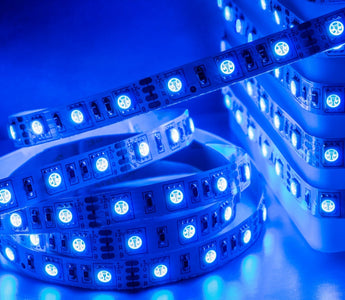
An LED strip arranges light sources along a strip format that can suit supported linear installations. Strips are useful for accents and some task applications, but the exact system determines the light quality, power equipment, permitted route and operating environment.
Match the application to the light
| Application | What matters |
|---|---|
| Shelf or wall accent | Appearance of the lit surface, concealed source and control access |
| Work-surface lighting | Useful coverage, shadows and environmental suitability |
| TV or gaming backdrop | Placement and an explicitly supported effect-input route |
| Long decorative run | Matched power, controller, connectors and extension limits |
Select the complete system
Check whether you are buying a standard kit, an extension or a component. Light Strip Pro distinguishes the control-box standard pack from its compatible extension. A similar-looking strip from another family is not automatically interchangeable. Use the manufacturer’s instructions for cutting, connectors, maximum supported arrangement and power rather than assuming any TV USB port can run it.
Check the installation before sticking it down
Inspect the surface, corners, exposure to heat or moisture and the path back to power. Keep required equipment accessible and use only the approved mounting method. A photograph of a strip in a kitchen, outdoors or behind a television does not establish that every strip is suitable for that installation.
Do not infer effects from the strip shape
White adjustment, colour effects, independently controlled sections, music response and screen matching are distinct features. For a reactive effect, check the actual signal source and supported software or hardware. Music or game integration alone does not prove direct television-picture synchronisation.







